
Muenbotoke: About People No One Is Looking For

Japan once feared forgotten ghosts. Today it creates two hundred of them every day.
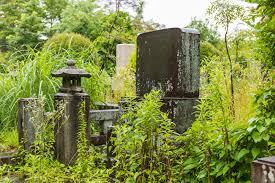 In Japanese folklore, there exists a category of spirits that defies classification as either demon or vengeful ghost. Muenbotoke (無縁仏) — literally “buddhas without bonds” — are the dead whom no one remembers. They have no altar, no grave, no descendant who would light incense each morning. For centuries, the Japanese attributed droughts, plagues, and unexplained illnesses to them. They were fed during the Obon festival — on a separate shelf, lower than the ancestors, on large taro leaves placed directly on the floor. Because ancestors had a right to the altar, while the homeless dead were entitled, at best, to mercy. Some of these spirits took the form of wind: whoever felt the breath of shōrōkaze on their face on the fifteenth day of Obon would fall ill and collapse. The word is old, and the fear behind it older still. But it turns out that this fear does not belong to the past.
In 2024, the Japanese police published comprehensive annual data for the first time in history: 76,020 people died alone in their own apartments. The bodies of over 4,500 were discovered a month or more after death. One hundred and thirty — after more than a year. That is two hundred people a day. In the concrete blocks of Tokyo, Osaka, and Kanagawa — but also in the depopulating villages of Shikoku. Over 80% are men, particularly those who have retired — because for decades the Japanese corporation was the only place where they learned to have friends. When the company cast them out, nothing remained: the wife had been living her own life for years, the children had long since moved away, the neighbors were strangers. When the body is finally found — by the smell, by uncollected mail, by a signal from concerned neighbors — a tokushu seisō crew enters the apartment, a company specializing in “special cleaning.” Twenty years ago, this profession did not exist. Today it is one of the fastest-growing service industries in Japan. A brown outline of a body on the floor. Stacks of newspapers, unfinished tea. A TV remote on the floor. Every such apartment — says Masatomi Yakoo, the head of one such company — is an unfinished exhibition of someone’s life, in which time has stopped.
And this is precisely where the medieval word becomes a diagnosis. Muenbotoke — spirits no one remembers — are no longer a folkloristic figure. They are a statistic. In Japan, where 30% of the population is over 65 and where every fifth senior lives alone, the ancient fear of being forgotten has materialized in the form of numbers that do not allow one to look away. Seventy-six thousand. That many solitary deaths in one year, in one country. Japan has outpaced the rest of the developed world by a good two generations — but the rest is catching up. What is happening today in Japan is a forecast for all of us. Japan is not an exception. It is a harbinger.
Japan Built on Bonds with the Dead
To understand what muenbotoke is, one must first understand the Japanese relationship with death. This is not about faith — for generations, the Japanese have situated themselves beyond any Western understanding of religiosity. In surveys, over seventy percent declare themselves “non-religious.” And yet — in more than half of Japanese homes stands a butsudan (仏壇 — lit. “Buddha’s altar”), a household ancestor altar before which incense is lit and food is placed each morning. Not out of faith. Out of obligation. Out of a sense that between the living and the dead there exists a contract that should not be broken.
The Japanese cult of ancestors — sosensuhai (祖先崇拝) — is something that Robert J. Smith of Cornell University called “the most common experience of a religious character that unites all Japanese.” It is not a doctrine. It does not require a creed. It is infrastructure — a system of reciprocity between the world of the living and the world of the dead, in which each side has its duties. The living tend to the graves, perform rituals, and offer food and incense. The dead, in return, protect the lineage, bring prosperity, and maintain the order of the world.
This system has a precise mechanism. After death, the soul of the deceased remains for years an individual spirit that requires specific rituals at specific moments — the seventh day, the forty-ninth day, the first anniversary, the third, the seventh, the thirteenth, the thirty-third. Only after thirty-three years (in some regions fifty) does the soul lose its individuality and merge with the sorei (祖霊 — lit. “ancestral spirit”), the collective spirit of the family’s ancestors. This spirit visits the living four times a year: during Obon, at New Year, and during the spring and autumn equinoxes. It is a cycle full of emotional logic: the dead do not vanish suddenly. They depart gradually, over a generation, until they become part of something greater than themselves.
During the Tokugawa era, this system gained institutional reinforcement. The shogunate, seeking to better control the population, ordered every family to register with a specific Buddhist temple — this was the terauke seido (寺請制度) system. From then on, Buddhist temples became the guardians of memory for the dead, and Buddhism in Japan transformed into what historians call sōshiki bukkyō (葬式仏教 — lit. “funeral Buddhism”). Not meditation, not enlightenment — funerals, anniversaries, fees. It sounds cynical, but for centuries this system guaranteed one thing: that no one would be forgotten. Everyone had their temple. Everyone had their grave. Everyone had someone who would come.
But What Happens When No One Comes?
Muenbotoke is the antithesis of this order. Someone who died outside the network — without family, without descendants, without anyone who would perform the ritual and pacify the soul. In Japanese folklore, such an untended spirit does not depart in peace. It wanders. It is hungry. And it is dangerous.
Since time immemorial, Japanese farmers attributed misfortunes — droughts, floods, insect plagues, violent winds — to the wrath of untended spirits. During the Obon festival, in addition to offerings for the spirits of one’s own ancestors, food was set out for the muenbotoke — on a separate shelf, lower than the household altar, on large taro leaves placed directly on the floor. Hierarchy was maintained even in gestures of mercy: ancestors on the altar, homeless dead on the ground. But both were fed — because the alternative was a curse. A separate Buddhist ritual existed: segaki (施餌鬼 — lit. “feeding the hungry ghosts”), a ceremony intended to soothe the hunger and rage of beings trapped in the realm of gaki (餓鬼), to which the souls deprived of the living’s care were consigned.
The mass “production” of muenbotoke occurred during the Sengoku era — during the civil wars of the fifteenth and sixteenth centuries, when masses of soldiers perished far from home, without families who could tend to their burial. Historian Morioka Kiyomi described this period as a time when the Japanese landscape became populated with restless spirits — those who fell on battlefields, nameless pilgrims who died on mountain trails, travelers killed at mountain passes. Folk legends about muenbotoke speak of spirits that possess passersby on steep slopes, causing dizziness and paralyzing the body. Diviners would diagnose: this is the spirit of someone who died here and never received a prayer.
A particularly dark figure were the hidarugami (ひだる神) — spirits of those who starved to death on mountain paths, which attacked travelers by inducing in them a sudden, incapacitating hunger. They were simultaneously yōkai, yūrei, and muenbotoke — they defied simple classification, because Japanese demonology is not taxonomy but narrative. In a legend from Aichi Prefecture, recorded in the archives of the Yana district, a man returning from a segaki ceremony — ironically, from a ritual meant to pacify precisely such spirits — suddenly felt dizziness and paralysis of his legs on a steep slope. A diviner declared that he had been possessed by a muenbotoke — the spirit of a pilgrim murdered on that very pass. The logic is haunting: even participation in a ritual offers no protection if the ritual did not encompass a specific, forgotten dead. The system had holes — and it was through those holes that demons entered.
Some muenbotoke took the form of wind. During the morning of Obon, there blew — so it was believed — the shōrōkaze (精霊風 — lit. “ghost wind”): the vengeful souls of those whom offerings had failed to pacify would set out on a journey upon the wings of the wind. In the city of Gotō in Nagasaki Prefecture, it was believed — as Mizuki Shigeru recorded in his encyclopedic Mujara — that whoever felt this wind on their face on the fifteenth day of Obon would fall ill and collapse. The word shōrō (精霊) — the same “spirited being” that in another reading, seirei, denotes a spirit in the Western sense — here carries a Buddhist charge: these are souls that found no peace in the cycle of birth and death. Muenbotoke are not evil by nature. They are hungry. Hungry for attention, for food, for prayer, for memory. And hunger, in the Japanese cosmology, is a state more dangerous than anger — because anger has a purpose, while hunger is blind.
Muen — From Freedom to Curse
There is something in the history of this word that should give us pause. Muen (無縁) — the very same “absence of bonds” that today sounds like a sentence — in medieval Japan meant something diametrically different. It meant freedom.
Amino Yoshihiko (1928–2004), a historian affiliated with Kanagawa University and one of the most important Japanese medievalists of the twentieth century, devoted a groundbreaking work to this concept: “Muen, Kugai, Raku: Nihon chūsei no jiyū to heiwa” (無縁・公界・楽――日本中世の自由と平和, 1978) — “Without Bonds, Public Space, Freedom: Liberty and Peace in Medieval Japan.” Amino demonstrated that during the Kamakura and Muromachi eras, there existed spaces called muenjo (無縁所 — lit. “place without bonds”) — temples, marketplaces, bridges, crossroads — that functioned as zones exempt from feudal authority. In these places, taxes did not apply, fugitive subjects were not pursued, slavery was not recognized. These were medieval sanctuaries in which the social hierarchy lost its force. People “without bonds” — monks, itinerant merchants, the social margins — formed their own communities in these spaces, governed by the principle of seniority, not birth.
Amino, himself a Marxist, saw in muen not a utopia but a proto-democratic practice — proof that Japan was not solely the hierarchical, feudal monolith it was taken to be. “Being cut off from bonds,” he wrote, “did not mean loneliness. It meant that power could not reach.” Ironically — or perhaps logically — this freedom from bonds was destroyed precisely by the unification of Japan under Tokugawa rule in the seventeenth century. The same shogunate that built the terauke system and guaranteed that everyone would have their temple and their grave simultaneously eliminated the muen spaces — because freedom without supervision was a threat to order.
Anyone who wants to understand today’s Japan of solitary retirees should keep this duality in mind. Muen once meant: I am free from obligations. Today it means: no one is obligated to me. The same freedom, turned inside out. And what was once a sanctuary — has become a sentence.
Isshinji — The Temple That Molds Buddhas from the Bones of the Forgotten
In the Tennōji district of Osaka, on a hill once famous for its beautiful sunset vistas, stands the temple Isshinji (一心寺 — lit. “Temple of One Heart”). It was founded in 1185 by Hōnen, the founder of the Pure Land school Jōdo-shū, who came here to practice nissokan (日想観) — meditation at sunset. Over the centuries, the temple grew, accepting urns with the ashes of successive generations of Osaka residents. By the end of the nineteenth century, it had collected more than fifty thousand.
In 1887, when there was no more room for additional urns, the head priest made a decision that would change Isshinji forever. He commissioned sculptors to mix the ashes with resin and cast from this compound a statue of Amida Buddha. The first okotsu butsu (お骨仏 — lit. “Buddha of bones”) was born. By the outbreak of the war, six such statues had been created. All were destroyed by the carpet bombing of Osaka in 1945. But after the war, the temple rebuilt itself — and that singular tradition as well. From the fragments of the six destroyed statues and the ashes of 220,000 newly deceased, the seventh buddha was cast. Then the eighth — from 160,000 people. The ninth — from 150,000. And so on every decade, up to the thirteenth. In total, the statues of Isshinji hold the remains of over two million people.
Isshinji accepts anyone’s ashes — regardless of faith, origin, or social status. Including the ashes of muenbotoke — the dead without family, without anyone who might tend to a grave. The fee ranges from 20,000 to 50,000 yen (approximately $130–330) — a fraction of the cost of a standard Japanese funeral, which can exceed a million yen (approximately $6,500). On one of the temple’s information boards, there is a sentence that stopped me:
一霊につき一壺のみ
ichi rei ni tsuki ichi tsubo nomi
“One spirit per urn.”
Hm…
Kodokushi — When Muenbotoke Are Born While Still Alive
Now let us step away from the temples, from the mossy stones and Buddhist statues — and enter a concrete apartment block on the outskirts of Tokyo. It is summer. There is a strange smell. The downstairs neighbor has been complaining for weeks. The mailman keeps adding notices to an already overflowing mailbox. Eventually someone calls the police. The officers enter. On the kitchen floor — a brown outline of a human body, etched into the linoleum by bodily fluids. Around it — empty takeout containers, cups of unfinished tea, TV remotes arranged in perfect order.
This is kodokushi (孤独死 — lit. “lonely death”). A phenomenon that has been rolling through Japanese society since the 1990s with the force of a silent epidemic — and that in 2024 was measured on a national scale for the first time.
The numbers are merciless. According to data from Japan’s National Police Agency, published in April 2025, over the course of 2024, the police handled a total of 204,184 deaths at home — including suicides and deaths from natural causes. Of these, 76,020 involved people living alone who were found dead in their own apartments. More than one-third of all deaths handled by the police. Seventy-six percent of these solitary deceased were 65 or older. The largest group — 14,658 people — were those over 85. Followed by 12,567 in the 75–79 age bracket and 11,600 aged 70–74. But kodokushi is not an exclusively geriatric problem: 780 people in their twenties, 1,013 in their thirties, and 62 teenagers between 15 and 19 also died alone and without witnesses.
The pace at which bodies are discovered tells us more about this society than any demographic statistic. Nearly 40% of the solitary dead were found the same day or the next — meaning someone still knew about them, someone called, someone noticed. But about 70% were discovered within a week — which in turn means that the remaining 30% lay there longer. Nearly 7,000 bodies — close to 10% of all cases — lay undiscovered for over a month. And 130 people — for over a year. There is a case from 2000 that became ground zero for public awareness of kodokushi: the body of a sixty-nine-year-old man from Tokyo was found three years after his death — rent and bills had been paid automatically from his bank account, and when the account was depleted, his skeleton was discovered (a strikingly similar case was recorded in Poland, at the Bolesława Śmiałego housing estate in Poznań). The very fact that the Japanese police only collected and published full annual data in 2024 is itself a symptom: for decades, kodokushi was not a problem to be measured. It was something one does not speak of.
Geographically, the phenomenon concentrates in large cities: Tokyo recorded 7,699 solitary deaths, Osaka 5,329, Kanagawa 3,659, Aichi 3,411. But this is not exclusively a metropolitan problem — kodokushi also affects rural Japan, where depopulating villages leave the elderly increasingly on the margins of social life.
Behind these numbers lies a precise demographic mechanism. In 1980, multigenerational households constituted half of all Japanese families. By 2015, their share had fallen to 12.2%. At the same time, 19.4% of Japanese over 65 now live alone — and according to projections from the National Institute of Population and Social Security Research, by 2050 the number of elderly people living alone will reach 10.8 million, and the total number of single-person households 23.3 million. Thirty percent of Japan’s population is now over 65 — the highest proportion in the world. The poverty rate among Japanese seniors is nearly double the OECD average. Many solitary elderly women in Japan live below the poverty line, which stands at 1,270,000 yen per year (approximately $8,200). And the most important indicator of isolation: only 38.9% of seniors living alone talk to anyone on a daily basis — compared to 80.9% of those living with others. Nearly half — 48.7% — consider a solitary death to be a “very real” or “rather real” prospect in their case.
There is also a dimension of gender that is rarely discussed, though the data screams. In research by the Tokyo Medical Examiner’s Office for 2018–2020, over 80% of kodokushi victims were men. This is no coincidence. The socialization of Japanese men — particularly those of the postwar baby boom generation — ran through the company: the corporation was the space for relationships, friendships, meaning. When a man retired or was forced into early career termination — which became widespread after the economic crisis of the 1990s — he lost not only income. He lost the only environment in which he knew how to function socially. His wife, if there was one, had been living her own life for years. The children had long since moved out. The neighbors were strangers. What remained was the apartment, the television, and silence. The average time from death to discovery for people under 65 is longer than for the elderly — suggesting that younger solitary dead were even more invisible to their surroundings than seniors.
Japan is a society that for centuries built its security upon the density of bonds. Everyone belonged to an ie (家) — the house-lineage. Everyone had their temple, their neighborhood, their gonin gumi (五人組) — a five-person neighborhood group whose members answered for one another. Now that network is unraveling. And the people who fall from it have nowhere to land.
Tokushu Seisō — The People Who Clean Up After Loneliness
When the body is found, the second act begins. A tokushu seisō (特殊清掃 — lit. “special cleaning”) crew enters the apartment. This is a profession that did not exist twenty years ago. Today it is one of the fastest-growing service industries in Japan.
Yoshida Taichi, founder of the company Keepers — one of thousands of such businesses in the country — entered the industry by chance: he moved from a moving company to cleaning up after the dead, seeking better earnings. Over time, he became one of the best-known advocates in the fight against kodokushi. Tokushu seisō cases now make up about one-fifth of all his company’s orders — two to three hundred annually out of fifteen hundred total. Workers enter in protective suits, with ozone machines and industrial-grade disinfectants. Bodily decomposition penetrates tatami, concrete, walls. The smell — as people in the industry say — is something one never gets used to (Anne Allison, Being Dead Otherwise, 2023).
Yet this is not ordinary cleaning. Before disposing of the deceased’s belongings, the crew often performs a brief prayer. Photographs are treated differently from other objects. There is a certain gravity in sorting through the possessions of someone who died alone — as if the gesture were meant to replace the funeral that no one organized. Masatomi Yakoo, owner of another such company, once said: “In apartments after a solitary death, time seems to stop.” The sentence sounds like a museum description — and in a sense, it is. Every such apartment is an unfinished exhibition of someone’s life.
There is also Miyu Kojima — an artist who works as a kodokushi cleaner and from the rooms she cleans creates miniature dioramas. Replicas of apartments in which someone died alone: the same unfinished drinks, the same stacks of newspapers, the same brown stains on the floor — only at a one-to-twelve scale. Kojima displays them at exhibitions so that people can see what solitary death looks like from the inside. At the Endex Japan funeral industry trade fair in 2015, visitors openly mocked her work: “This can’t happen to me.” Kojima drew attention to something important — that the very word kodokushi, “lonely death,” is unfair. Most people who die this way were not loners. They led normal lives — until a certain point. She proposed using the term jitakushi (自宅死 — lit. “death at home”). Because the problem is not that these people were lonely. The problem is that at some point they became invisible.
After cleaning, the apartment receives the status of jiko bukken (事故物件 — lit. “property with an incident”). Japanese law requires informing future tenants about what happened in the unit. In practice, apartments after kodokushi stand empty for months or years, because no one wants to live in them. A solitary death means a loss not only human but material — for owners, for neighbors, for the entire residential community. In a sense, muenbotoke still bring bad luck. Only the mechanism is now economic, not spiritual.
Muen Shakai — The Society Without Bonds
In January 2010, Japan’s public broadcaster NHK aired a documentary titled “Muen shakai” (無縁社会 — lit. “Society without bonds”). The film was like a cold shower. It showed case after case: retired men who, after leaving their corporations, had no one. Divorced, childless, alienated — not through ill will but because modern, urban Japanese culture had not taught them to build relationships outside the structures of company and family. When the structure vanished — they were left alone.
The term muen shakai entered public discourse immediately and has remained there since. It describes a society in which traditional bonds — family, neighborhood, company — disintegrated faster than new ones could be built. Japan became a laboratory in which global trends — atomization, urbanization, population aging — reached extreme consequences earlier than anywhere else. It outpaced the rest of the developed world by a good two generations — but the rest is catching up. What is happening today in Japan is a forecast for all of us. Japan is not an exception. It is a harbinger.
But returning to distinctly Japanese terrain — there is also a cultural trap at play. The Japanese concept of meiwaku (迷惑 — lit. “trouble, burdening others”) paradoxically accelerates isolation. Elderly people do not call their children so as not to bother them. They do not ask neighbors for help so as not to be a burden. They do not contact social services because that would be an admission of failure. Meiwaku is identified as one of the four key cultural factors deepening the phenomenon — alongside the repression of death so prevalent in twenty-first-century civilization, the weakening of neighborhood bonds, and economic instability. A study by the Nisseikiso Research Institute in 2011 indicated that approximately 80% of kodokushi cases involve self-neglect. Not sudden death, not an accident. A slow, quiet withdrawal from life — giving up doctor’s visits, food, opening the door.
There is also the problem the Japanese call “the 8050 problem” (8050問題) — parents in their eighties still supporting their children in their fifties, most often hikikomori — people in extreme social isolation. When the parent dies, the child — who has not left the house for decades — immediately becomes a candidate for the next kodokushi. It is a system of connected vessels: one form of loneliness breeds another, and demographics ensure that the scale of the phenomenon will keep growing. Already today, every sixth Japanese person over 65 suffers from dementia — and by 2040 their number will grow from four to nearly six million. Many of them will be living alone. The wave of solitary deaths has not yet crested — the only question is how high it will reach.
Masaki Ichinose from the Death and Life Studies program (死生学, shiseigaku) at the University of Tokyo hypothesized that the rise of kodokushi is directly linked to the contemporary culture of avoiding thinking about death. A few hundred years ago, the Japanese confronted death daily — bodies were buried personally, dying happened at home, among loved ones. Modern civilization has delegated death to hospitals and funeral homes, rendering it invisible. And what is invisible — is easier to ignore. In a country that for centuries built its civilization on bonds with the dead, the dead have become strangers.
It would be too easy, however, to treat kodokushi as an exclusively Japanese phenomenon. South Korea has its equivalent — godoksa (고독사), originally derived from the same characters. Singapore, Hong Kong, the great cities of China — everywhere the number of solitary deaths going undiscovered for weeks is growing. Even in Europe and North America, where social structures look different, research shows that loneliness is comparable in terms of health risk to smoking fifteen cigarettes a day. Japan is not an anomaly. Japan is the future — and every aging society in the world is heading in the same direction, just with a delay. Muenbotoke is not an exotic Japanese fear. It is a universal question of the twenty-first century: what happens to a person when the network of bonds that sustained them ceases to exist? And the first generations that will have to face this directly — may well be ours.
The Lit Incense
In 2024, the Japanese government introduced a law aimed at combating loneliness and social isolation — the first such legislation in the world. A sum of 5.3 trillion yen (approximately $34 billion) was allocated to support families with children, in the hope that reversing the demographic trend would reduce the loneliness of future generations. Local programs are emerging: volunteers patrolling the homes of the elderly, motion sensors in apartments, apps connecting seniors with volunteers. In Okinawa — where traditional neighborhood bonds survived longer than in the rest of Japan — kodokushi rates are lower.
In the Tokiwadaira housing complex near Tokyo, which in the 2000s became a symbol of solitary deaths, the local community organized a support system: helplines, social activities, regular visits to elderly residents. It helped — but it was not enough. Experts know that local initiatives patch holes in a fabric that can no longer be sewn with old thread. The change must be structural — and Japan changes its social structures at tectonic speed: slowly, with resistance, and with a deep fear of movement.
For centuries, Japan has said that there is something worse than death: being forgotten. Muenbotoke is a concept that was meant to describe ghosts. And it became a mirror. And the question that falls from it is not exclusively Japanese. It is human. Simple and merciless — who will light incense for us?
>> SEE ALSO SIMILAR ARTICLES:
Johatsu – on average, every year over 80,000 Japanese people disappear. They call it 'evaporating.'
Rent-a-Sister: A Japanese Method for Handling Extreme Isolation


"Strong Japanese Women"
see book by the author
of the page
未開 ソビエライ
An enthusiast of Asian culture with a deep appreciation for the diverse philosophies of the world. By education, a psychologist and philologist specializing in Korean studies. At heart, a programmer (primarily for Android) and a passionate technology enthusiast, as well as a practitioner of Zen and mono no aware. In moments of tranquility, adheres to a disciplined lifestyle, firmly believing that perseverance, continuous personal growth, and dedication to one's passions are the wisest paths in life. Author of the book "Strong Women of Japan" (>>see more)
Personal motto:
"The most powerful force in the universe is compound interest." - Albert Einstein (probably)
Mike Soray
(aka Michał Sobieraj)
未開 ソビエライ
An enthusiast of Asian culture with a deep appreciation for the diverse philosophies of the world. By education, a psychologist and philologist specializing in Korean studies. At heart, a programmer (primarily for Android) and a passionate technology enthusiast, as well as a practitioner of Zen and mono no aware. In moments of tranquility, adheres to a disciplined lifestyle, firmly believing that perseverance, continuous personal growth, and dedication to one's passions are the wisest paths in life. Author of the book "Strong Women of Japan" (>>see more)
Personal motto:
"The most powerful force in the universe is compound interest." - Albert Einstein (probably)
Mike Soray
(aka Michał Sobieraj)
Write us...
Ciechanów, Polska
dr.imyon@gmail.com
___________________
inari.smart
Would you like to share your thoughts or feedback about our website or app? Leave us a message, and we’ll get back to you quickly. We value your perspective!