
The Man Who Plays Himself — the Psychology of the Japanese “Shujin” Dilemma: Host or Prisoner?

Being Yourself, Correctly
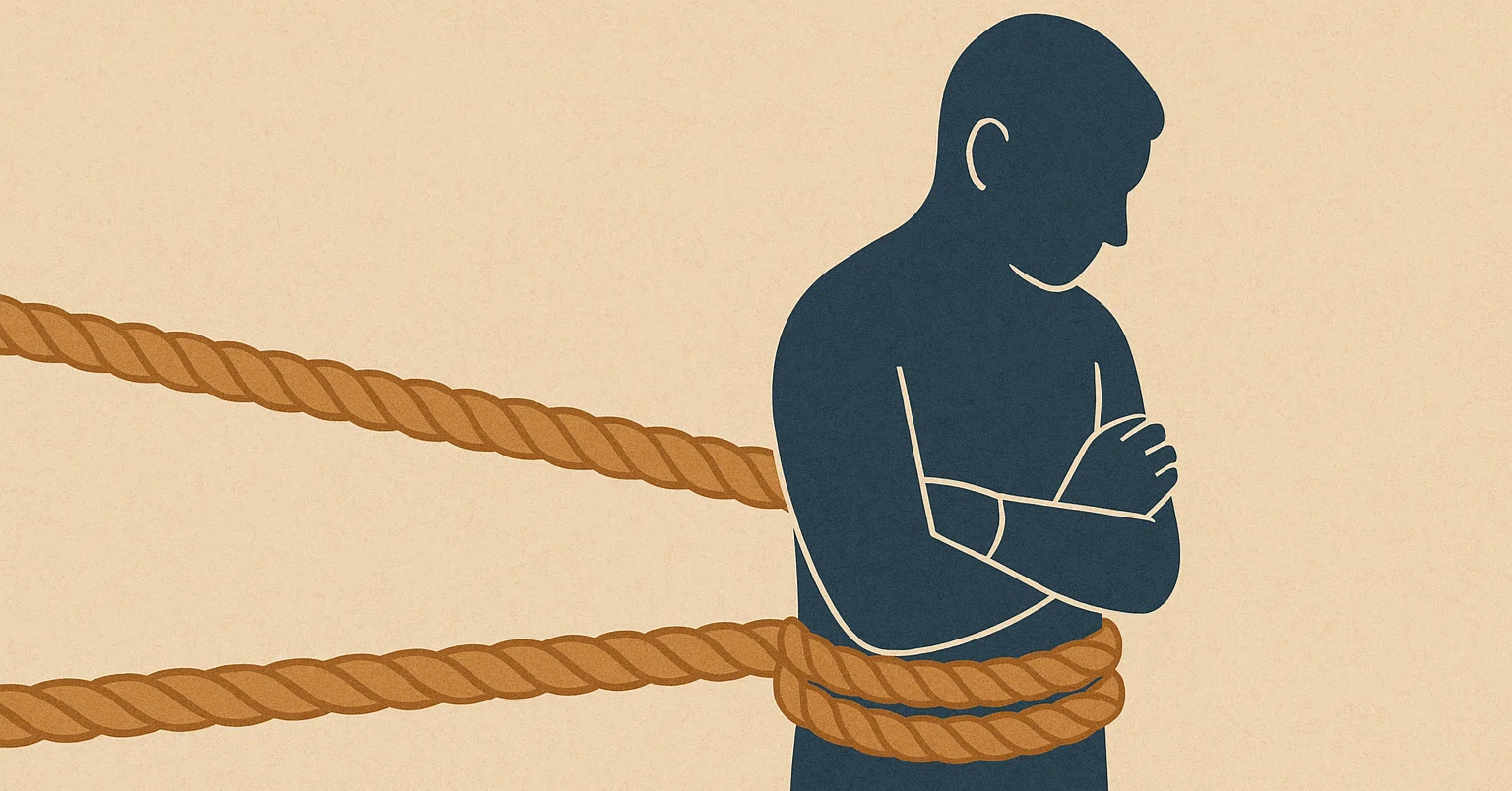 If you have ever felt that you are only playing yourself like a character in a performance, then you already know what shūjin (囚人) is. And “shujin” (主人)—a word spoken in passing, polite, smooth as a bow—can lead to the very same cage. In that single sound lies a tension Japanese literature has known for a long time: 主人 (shujin) — “host, master of the house, husband,” and 囚人 (shūjin) — “prisoner.” Two spellings, similar phonetics; two roles that can overlap so tightly that, after years, a person can no longer tell whether roles are still tools—or have already become the person himself.
 Today’s text will not be a story about some exotic “over there.” It will be more like a magnifying glass: it will reveal a little of Japan from the inside—through language, through the psychology of relationships, through the small gestures of everyday life that “don’t need” to be explained, because “everyone knows.” In a culture researchers describe as a world of the “interdependent self,” a person learns to exist in an entanglement of bonds: to regulate emotions, read the situation, protect harmony, anticipate consequences. This can be beautiful and mature—and it can also become heavy when a role begins to grow inside a person like a second skeleton. The literature of Akutagawa and Dazai can capture precisely that moment: when the mask stops being a tool and becomes a way of breathing.
 Because “prison” does not always look like violence. Sometimes it looks like order, like predictability, like warmth under the kotatsu, like being “good,” “responsible,” “solid.” And yet at some point a person realizes that the guard is no longer standing by the door—he is sitting inside: in self-censorship, in apologies that come too quickly, in the reflex of “what will people think?” And then the question Japan leaves us with turns out to be painfully universal: can one be someone’s “主人” (host)—responsible, needed, mature—without becoming a “囚人” (prisoner) of other people’s expectations and one’s own ideals?
Returning Home
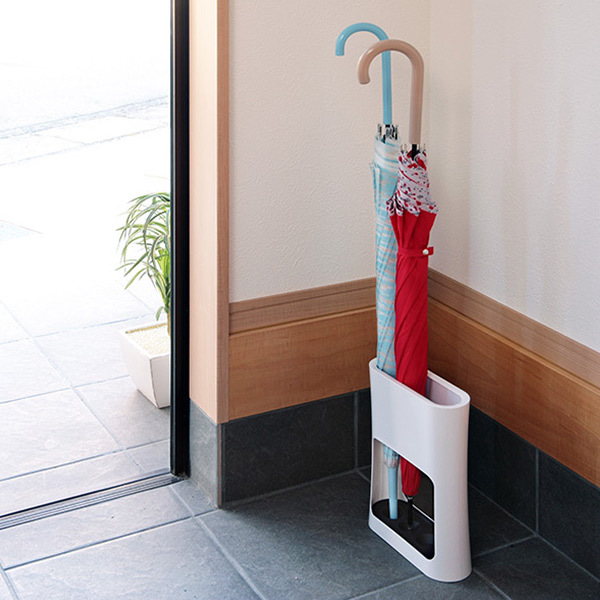
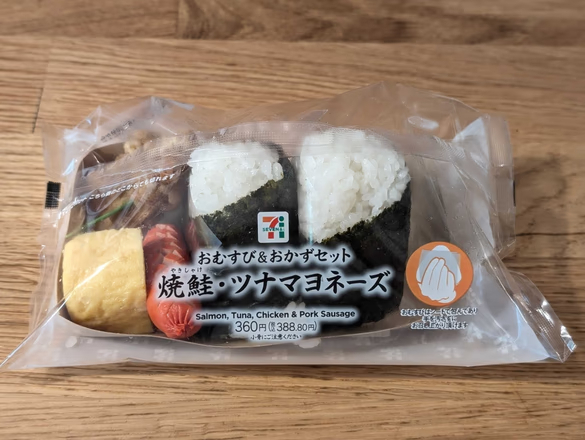
 In the hallway it smelled of wet nylon and cheap detergent. On the floor, right by the entrance to the apartment, stood a plastic tray for umbrellas—someone had once bought it in Daiso because it was “just right,” safely bland and transparent. Inside, drops fell from black, folding kasa, and beside it, on a folded newspaper, lay a small bag from the konbini: two onigiri (one with umeboshi, the other with kombu), a can of Strong Zero with a lemon label, and small green Rohto eye drops—today’s salaryman uniform: a tie in the morning, eye drops in the evening.
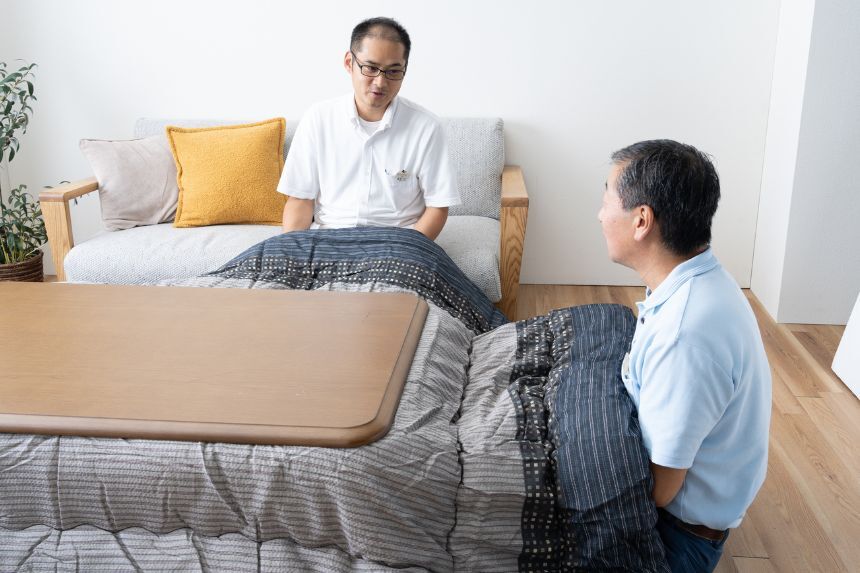
 The apartment was typical of new Tokyo: a 2LDK in a housing block where the walls are thin and silence comes with its own rulebook. In the living room, between the low table and the television, stood a kotatsu, still covered with a blanket in a tiny pattern, because winter in urban Japan is rarely a drama of snow; more often it is a drama of cold hands. On the dresser lay documents in a neat stack: shakai hoken, a leaflet from the ward office about garbage segregation, an envelope from the bank, and on top—a white sheet in that familiar printed style: a reminder about the neighborhood association meeting, with a stamp that looked like the touch of someone else’s hand.
From the bathroom came a sound every Japanese apartment knows: the short, polite signal of a washlet. Then the click of a closing door and muffled footsteps. She came out first—barefoot, hair tied with an elastic band, in a tracksuit as practical as her smile. She stopped in the doorway, looked at the konbini bag, and immediately counted in her head what she did not say.
—Okaeri—she threw out, but without the softness you put into the word when you want it to mean “I missed you.” Now it meant rather: “you’ve returned to your role.”
He, still in his coat, briefcase in hand, answered automatically:
—Tadaima.
 Between them hung something that in Europe might be “an unspoken thing,” and here was the load-bearing structure of the whole house. There was no fight, no drama. There was function. There was mechanism.
In the kitchen, on the counter, stood a bag of rice with the word “Niigata” on it and a small bottle of soy sauce. On the refrigerator door hung a magnet with a cat and a sheet with the schedule: Tuesday—plastic, Wednesday—bottles, Friday—burnables. A world in which every piece of waste has its day, and garbage collection sets the rhythm of the week—a world already fully underway.
— Did you eat anything? —she asked, though the answer lay on the table in konbini plastic.
—There was no time — he replied. His voice still had the corporate tone, slightly raised, polite, as if he were speaking to someone who might later tell a story about him. As if the walls had ears.
 Before he took off his shoes, he adjusted his sock. Then carefully slid his feet into house slippers—ones embroidered with the word “Hello,” because once she had found them cute. He made the movement with the precision of a person who cannot stand chaos, because chaos reminds him that things are not under control. At the office his desk was clean; even the Windows desktop seemed clean: ordered windows, ordered folders, an ordered man.
—Shujin wa?—her father called out from the living room, a man who had come “for a few days” and had already stayed a week. He sat at the kotatsu, watching the news. His legs were tucked under the blanket, hands on his knees, and he looked as if he had lived here forever. The question was innocent in the way a knock on the door at six in the morning can be innocent.
She answered smoothly, without a stutter:
— He’ll greet you in a moment, he just needs to change.
 And then that word—shujin—passed through the room like an electric current everyone is used to. Ordinary etiquette, like “please,” like “thank you,” like a bow you make even when no one is watching. Except he felt it. The way one feels the key in one’s pocket that cannot be lost, because an entire life depends on it.
In his mind he saw two images, as if superimposed.
The first was bright and pleasant: “shujin”: 主人—host of the house, the one who has stability, a permanent job, a mortgage, a company business card, a shirt ironed on Sunday, a watch that is no longer an ornament but proof that “everything is going well.” The one whose opinion is asked because “he is the master of the house.” The one whose existence holds the family together like a beam in the ceiling.
The second was darker and more true: “Shūjin”: 囚人—a man closed within a frame. Not in a prison with bars, but in the frame of daily expectations. In a frame shaped like an office building, a timetable, a work email, a meeting on Monday morning, a smile at a nomikai (one of the types of obligatory drinking sessions with the boss after work), where you have to laugh at your superior’s joke even though the joke is as old as the faded ganbaru (“110%!”) poster in the office elevator.
 He went into the bedroom to change. In the closet, shirts hung perfectly straight, all in the shade of “safe white.” Next to them a suit, next to that black trousers, next to that a belt. Things that were not his taste—they were his function. In the corner stood a sports bag. He runs every morning in the park, because everyone knows successful people take care of their health, and he wanted success.
In the mirror he saw a face that could look calm even when inside someone was scraping fingernails against the walls. He rolled up his sleeves and for a second he wanted to scream, the way one sometimes screams in a car in rage on an empty road, pounding fists on the steering wheel—but here there were no empty roads. Here there is always someone: neighbors, family, the company, the city, the gaze. Seken—the invisible audience that doesn’t need to say anything, yet hears and sees everything.
He returned to the living room in a home sweater, a little too warm. He sat by the kotatsu. His father-in-law nodded, as if approving his return to his place.
— On the news today they talked about staff cuts—said his father-in-law, in the tone of a man who does not ask, only reminds. —In your company too?
He didn’t know why, but it hurt. He answered politely, with a slight bow and a calm, pleasant tone.
— Nothing is known yet.
In that short exchange there was no violence. There was culture. There was form. There was Japan, which keeps a person in line even if at first glance you cannot see it.
She placed on the table a small plate of tamago-yaki and a bowl of miso-shiru. Everything was correct, warm, homely. And yet a dryness appeared in his throat, as if he had swallowed paper. He thought that he was “master” and “prisoner” at the same time: 主人, because everyone says so; 囚人, because everyone expects so. And that the worst part is that at some point you stop being able to tell where other people’s expectations end and your own begin.
Above the kotatsu hung a silence you could cut with a knife. On television the reporter spoke about the yen exchange rate. His father-in-law chewed slowly. She opened the Strong Zero can—pssst. He put his hands to the warmth under the blanket and for a second felt that this pleasant temperature was exactly what kept him inside the cage: comfort that is also a bar.
Outside, beyond the window, someone on a balcony was shaking out a mat. From the neighboring apartment came the little melody of a rice cooker. Life went on, smooth, orderly, organized like garbage collection schedules. And he sat inside that world and already understood that “shujin” is not only a word. It is a position in a sentence, a position in a house, a position in society. And a place one does not leave easily, because even the door looks like a solid wall.
First, the Layer of Language
Two cages that overlay each other
“Shūjin” as 囚人 means “prisoner”—a man shut in, literally imprisoned. “Shujin” as 主人 means “master / host”—someone who “runs the household,” “is the head,” and in everyday language very often: “husband.”
And now the most important thing: these two worlds meet not in a dictionary, but in life. Because 主人 (shujin) is not a neutral “husband.” This word carries an echo of a power relationship: “someone is the host; someone enters his house; someone is the master; someone serves him.” And even if today no one is thinking in feudal categories of “master–servant,” language has its own memory: it can press a person into a form before he has time to ask whether that form fits him at all.
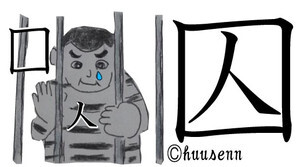
It is worth taking apart the first character from “prisoner”: 囚 (shū). It is one of those characters that are brutally legible: inside an enclosure (囗) stands a person (人). The graphic intuition is immediate—someone has been “taken into a frame.” And it does not have to be the frame of a prison with bars (though it can be—literally, “to imprison” is 囚禁). In a culture of roles, it can just as well be a linguistic frame, a customary frame, a family frame, a corporate frame. A frame with no guard, because the guard is already sitting inside: in the head.
“主人 (shujin)”—a polysemous word: host, master, husband… and the cost of that polysemy
What is most interesting (and most dangerous) about 主人 (shujin) is that it works on several levels at once.
- The household level: “host of the home,” someone “responsible,” “the one who handles things.”
- The relational level: “master”—a word that historically easily arranges the world vertically: someone is “above,” someone “serves.”
- The marital level: “husband”—especially in the usage where a wife speaks about her husband to a third person (and in various other situations; we will not go into that now).
This polysemy is not only a curiosity. It does something to the psyche of speaker and listener. When a woman says in conversation: “うちの主人が…” (“at our place, shujin…”), grammatically it is simply “my husband.” But semantically—in the background—there appears a host, the master of the house, someone representing the family outwardly. And language has this property: even if you use it “only as code,” the code still shapes reflexes—who is responsible for finances, who has the “final” voice, who is the “face” of the household in social contacts.
Therefore “shujin” can sound soft and everyday, and at the same time work like a very old mechanism: not through aggression, but through normality. In many people’s speech, “主人 (shujin)” sounds neutral—because it is familiar, “it has always been so,” “everyone says it.” In other people’s ears it sounds hard—because they hear in it the feudal aftertaste of “master” and the vertical axis of the relationship (and a relic of times when women were subordinated). Japan has a particular ability to smooth this tension: the weight can be “invisible,” because it is dissolved into politeness, ritual, an elegant form.
The debate about “主人” (shujin) returns in waves and always sounds almost the same. The Japanologist and linguist Endō Orie, reviewing postwar decades of the press (from the 1950s), shows* that discussions about “removing” “主人” from marital language reproduce, over and over, the same pattern of three arguments:
“This is a feudal remnant—let’s remove the word.”
“But today there is no master–servant relationship, so it can be used.”
“It’s only a sign/label; no need to add ideology.”
*遠藤織枝 (Endō Orie), „配偶者の呼称『主人』の盛衰小史” („Krótka historia wzlotów i upadków określenia współmałżonka „shujin”). Ukazało się w „日本語とジェンダー” (Nihongo to Jendā / Japanese Language and Gender), 第21号 (2023).
This is fascinating, because these three voices are sometimes presented “as if they were equivalent”: as if the matter concerned only linguistic taste, and not a power arrangement hidden in an everyday word. And here appears a braking mechanism that is uniquely Japanese in its subtlety: when someone says, “instead of referring to my husband as shujin, I will say otto (夫),” the counterargument immediately returns: “fine, but what will you call someone else’s spouse?” What to do with “ご主人 (go-shujin)”—the polite expression for “someone’s husband”? If there is no perfect substitute, the language remains with the old one. That is precisely why change is not only a question of a moral decision—it is a question of an entire network of registers and politeness.
Seken
And now we come to the word without which the “prison of roles” in Japan is difficult to describe: 世間 (seken).
“Seken” is sometimes translated as “society,” “world,” “public opinion,” but that is always a flattening. Seken is not an abstract community of citizens. It is rather a field of gazes, a dense network of relationships and evaluations in which a person lives as in an aquarium: even if no one says anything, you feel that you are being seen. Hence old and still living expressions like “世間に出る” (seken ni deru—“to go out into the world”) or “世間を渡る” (seken wo wataru—“to make one’s way through the world”)—as if life were not so much “self-realization” as moving across terrain with unspoken rules.
We have here one more important historical contrast: in medieval Japan there existed the concept of 公界 (kugai)—the “public sphere / public world,” associated with urban culture, markets, spectacles, a space of encounter. Later this “publicness” in certain places took on a dark reverse: 苦界 (kugai)—a “painful world,” for example as a term for pleasure quarters, where “the public” became an isolated, suffering microcosm (we write about such suffering here: Born in hell, buried in Jōkanji – what have we done to the thousands of Yoshiwara women?). This historical shadow matters, because it shows that “the world” in Japan is not neutral: it has the taste of belonging and the taste of banishment. And seken is often precisely the mechanism that divides: who is “inside,” and who suddenly ends up “outside.”
In this light it becomes clear why “shujin” is a literary and psychological topic, not only a linguistic one. Because if 主人 (shujin) is a role meant to maintain the order of the household and the face of the family, and 世間 (seken) is the audience that evaluates that order, then it is easy to understand how a person becomes 囚人 (shūjin)—a prisoner without bars. It is enough that he begins to believe there is no other way of existing than “correctly fulfilling one’s function.”
The Psychology of the Japanese “Self”
The interdependent self, that is: an identity built between people
If we want to honestly describe why in Japan it may be easier than in the West to become a “prisoner of a role,” we first need to reset one thing in our minds: the “self” is not there by default a monolith that “comes from the inside outward.” Hazel Rose Markus and Shinobu Kitayama, in the classic work I recommend to Readers interested in the subject—“Culture and the Self”—describe the difference between an “independent self” (typical of many American contexts) and an “interdependent self” (characteristic of many Asian cultures). The latter assumes that an individual is fundamentally connected to others—his identity is formed and maintained through relationships, obligations, adjustment, and harmony.
This matters, because in such an arrangement “being yourself” does not mean: “express your own truth no matter what.” It often means: being able to exist in relation in a way that does not wound the whole. Markus and Kitayama show that this is not only a difference in custom, but in the very way experience is constructed: how people understand themselves, how they feel emotions, what motivates them, and how they make decisions.
From this perspective “shujin” (主人) ceases to be only a word. It becomes a relational node: a role that exists because others exist in relation to it—family, company, neighbors, “the world”—and because it maintains a visible order. And a role that maintains order easily turns into a cage.
What does this imply for emotions and motivation?
If the “self” is interdependent, then emotions also arrange themselves differently. In such a world, relational emotions acquire particular significance—emotions tied to evaluation, fitting in, having the proper place in the group, rather than only to the realization of a personal desire. In practice this means greater weight placed on what, in a European reflex, we often push into the category of “too much sensitivity”: shame, embarrassment, the feeling of being “out of place”—emotions that function like sensors for a breach in relationships.
What from the outside is sometimes called “conformism,” from the inside is often a technique of social survival: the ability to keep bonds and avoid a fracture in the structure of the group. Hence the importance of a competence that many Japanese develop from childhood almost intuitively: “I read the situation” (I read the arrangement, the context, the tension, the hierarchy, what can be said and what is better left unsaid—more about this here: Omoiyari and the Culture of Intuition – The Deepest Difference Between the European and Japanese Mindsets?). Markus and Kitayama show that in cultures of interdependence “fitting in” is not an addition to personality—it can be the core of agency.
Here it is worth adding a second, very Japanese piece of the puzzle: Takeo Doi and his famous “amae” (甘え)—the desire to be accepted, to be “held up” by a relationship (we devoted an article to “amae” here: Amae (甘え) – a Japanese word unveiling a feeling the West leaves unnamed). Doi saw in this a key to the Japanese dynamics of dependence and care, in which closeness and hierarchy can exist simultaneously: one can be “weak” toward someone higher, and at the same time feel safe in it. In such an arrangement shame and self-control do not have to be only oppression: they can be the “price” for maintaining a network that offers support.
Here we reach the point where we Westerners can easily make an unconscious mistake. Because one could describe this naively: “the Japanese suppress themselves.” And that is too simple a description—moralizing and too convenient. Maturity in many Japanese contexts does not consist in maximal expression of the “true self,” but in the art of regulating oneself: setting one’s emotions, words, and gestures so that the relationship endures and the shared reality does not crack. Markus and Kitayama show that in a culture of interdependence “to function well” often means “to be able to fit”—and that this ability is valued like a moral skill.
That is precisely why the “prison of roles” can be so effective: because it is sewn into maturity. A person stops asking: “do I want this?” and begins to ask: “is this appropriate in this situation?” And often this is not the question of a hypocrite—it is the question of a responsible person who understands that his movements have consequences for others.
But in the same place a crack is also born: if the “self” exists mainly as relationship, it is easy to end up with a life in which there is no longer any space for a private breath. Then the paradox appears: a person becomes the perfect “主人” (host, pillar), and at the same time feels like 囚人 (prisoner)—because the guard of the role is already sitting inside him. And you do not need bars to understand that some doors cannot be opened.
Literature Can Be Our Guide
Akutagawa—truth as a polyphony of justifications
In Akutagawa, the mask is not a prop; it is a cognitive technique. In the story “Yabu no naka” (“In a Grove,” 1922), we do not have one “self” that speaks the truth, but a series of voices, each of which becomes, for a moment, someone else: a witness, a victim, an accused, a moralist, an actor in his own defense. Akutagawa builds a narrative out of the shifting situational and psychological roles of the characters: the same person can, in successive testimonies, jump between the position of a proud warrior, a wronged man, an opportunist who justifies himself, or a tragic victim—depending on which role gives him a momentary possibility of saving face.
And here we arrive at the core of our “shujin.” Because the “prisoner of a role” in Japan is rarely the prisoner of a single lie. He can be a prisoner of a continuous reconstruction of the self—one that does not aim to uncover truth, but to maintain position before an audience. Akutagawa therefore does not ask: “who killed?” He asks: “how does a person narrate himself when he knows he is being watched?” In this sense “Yabu no naka” becomes a story about seken even before that word appears on our lips: about an invisible audience that causes identity to behave like testimony.
One can connect this construction with the modernist experience of the impossibility of “ultimate truth”: truth disperses, because each “self” speaks from a different place and in a different direction (as does the scholar from the University of Nagasaki Eugenia Prasol in her work “The Quest for Ultimate Truth in Ryūnosuke Akutagawa’s ‘In a Grove’”).
And when truth stops being stable, role begins to be everything. This is Akutagawa in his sharpest form: a person not only wears a mask—he breathes with the mask, and the mask becomes the only possible way of speaking about himself.
A bridge to Dazai: the “self” as performance and self-accusation
If Akutagawa breaks role down into the mechanics of narrative, Dazai breaks it down into the mechanics of the heart. “Ningen shikkaku” (“No Longer Human” / “Zatracenie,” 1948) is not simply a novel about downfall. It is a study of a person who from childhood learns one thing: you will survive if you play the right character. Yozo Ōba does not build a “self” like a house; he builds it like a stage. His basic reflex is not “to be,” but to perform—to amuse, to fit in, to disappear into other people’s expectations before others have time to name him.
In “Cambridge History of Japanese Literature,” Dazai is described as an author whose late novels (“Shayō,” “Ningen shikkaku”) struck a postwar nerve: a sense of moral and existential fragmentation, the experience of the individual’s “non-fit” with a world that expects normality. And here we can see how the theme of “shujin” changes color: Dazai shows that at some point the role stops being something you put on for a moment. It becomes skin. And when the skin belongs to someone else, a person begins to live in a permanent tension between the need to be accepted and the fear of being “unmasked.”
This is also literature of escape that is not escape: alcohol, affairs, self-destruction—everything looks like a way out of the cage, but in truth it is only a change of scenery. Because the core remains the same: a self dependent on the gaze of others. And that is precisely why Dazai is so close to our “shujin–shūjin” axis: his hero is a “prisoner” not because someone locked him up, but because he learned to live as if he were always on stage.
Yoshimoto Banana: the soft cage of everyday life
With Yoshimoto there is no Akutagawa sharpness and no Dazai blood. There is something more treacherous: soothing everyday life that can function like a cage because it is pleasant, meaningful, and “good.” In “Kitchen” (1987), the center of the world is the kitchen—a space of care, food, repetition, gestures that heal. And here it is easy to make an interpretive mistake: to assume that it is only “comfort literature.” Meanwhile more serious studies read Yoshimoto as a writer who shows how the “self” is built under the influence of others, in a network of care, dependence, and domestic forms.
Akiyoshi Suzuki points out that “Kitchen” resonates with young audiences also because it creates a “private enclave” in the world of late modernity: a place where one can disappear from pressure for a moment—but also a place that begins to define identity. And here is our “shujin” in a soft version: the hero is not pressed against a wall by the violence of a role, but wrapped in a role of care, gratitude, “being needed.” The role does not shout. The role calms. And because of that it is easier to mistake it for the truth about oneself.
All these examples—how true they seem—after all, not only in Japan…
Why This “Prison” Is Also Protection
The word “prison” works on us like a sentence: it is associated with violence, with harm, with someone who locks you up. And yet in the Japanese world of roles the greatest effectiveness lies in the fact that the bars are often made of things that make sense. A person does not hold on to his role only out of fear. He also holds on to it because the role is a structure of meaning: it orders relationships, gives predictability, divides duties, allows one to “know what to do” in situations that would otherwise be chaos.
Markus and Kitayama describe the culture of the interdependent “self” in a way that reveals not weakness, but a different ideal of maturity: the emphasis on fitting in, on tuning oneself to others, on harmonious interdependence.
This is not only social pressure; it is also a form of competence. In such an order a role can be like a handrail on steep stairs: it limits freedom of movement, but it allows you to climb higher without falling. It gives belonging, and belonging gives a person the feeling that he is not alone.
The problem begins when the handrail turns out to be a gate: you will pass only in the way the system anticipates. Then what was protection becomes a cage of meaning. Not because the role is bad, but because it can be total: it occupies language, gestures, emotions, the day’s schedule, and sometimes even imagination about what one is allowed to want.
It is also worth striking at a very frequent Western reflex of moralizing: “they have no individualism.” Such a judgment is too convenient. First, “individualism” is not one universal essence—it is a historical cultural project. Second, in a culture of interdependence it is not about the lack of a “self,” but about a different placement of the self: not “inside, against the world,” but “inside relationships, toward the world.”
Only on that axis can we honestly describe the costs: greater susceptibility to shame, greater vigilance toward evaluation, greater labor of self-control. But also the benefits: group coherence, predictability, a high level of situational competence.
This is, in essence, a story of ambivalence: role protects because it builds a world—and at the same time role binds because it builds a world that is too sealed.
“A Prisoner of the Self”—How a Person Internalizes the Guard
What is most moving in the mechanism of “shūjin without bars” is that it often needs no external executioner. It is enough that expectations are moved inside. Then the guard no longer stands at the door—the guard sits in the person.
In cultural psychology this is clear: if the “self” is interdependent, then the “self” naturally includes others as part of its own construction. This affects emotions and motivation: a person more often regulates himself in terms of relationships, anticipates consequences, strives for “proper” behavior in context.
In such an arrangement the sentence “what will others think?” is not only fear. It is a built-in orientation mechanism that works even when no one is watching.
And when we add seken—not society as an abstraction, but a field of gazes, reputation, circulating judgments—internalization becomes even stronger. Tadahisa Izeki (a Japanese historian and cultural scholar from Chūō University) shows* that “seken” is a culturally bound concept difficult to translate precisely because it contains something of “audience” and something of “a world one must pass through.”
*Tadahisa Izeki, “Problems of Translating Culture-Bound Terms: Taking ‘Öffentlichkeit’ and ‘Seken’ as Examples”, Shaping Asia Working Papers, no. 2, 2022 (Bielefeld University / Heidelberg University).
It is a “world” that can accept you and can cast you out—and therefore a person learns to move carefully, softly, so as not to scratch the surface of relationships. Here the role enters the body. It is no longer a choice of words in conversation. These are micro-gestures: how quickly you nod before someone finishes a sentence; how early you say “sumimasen” before you have truly done wrong; how long you remain silent so as not to crush the atmosphere; how you “swallow” a reaction because the reaction might be too vivid, too personal, too “me.”
This is a “prison” that works subtly: through self-censorship and self-regulation that pass for maturity. And here our double sound returns: a person becomes “主人”—a pillar of the home, a representative, a function—and at the same time inside can be “囚人”: someone closed within the frame of expectations, even if no one locks him up.
And one more detail, very Japanese in its logic: even if someone wanted to change the language of the role, change meets resistance from the politeness system. The linguist Endō Orie cited at the beginning shows how in the postwar debate about “主人” the same trio of arguments returns over and over, and a particularly effective brake sounds like: “fine, you can refer to your husband differently, but what will you call someone else’s spouse—what will you do with ‘ご主人’?”
It is a small linguistic detail that reveals a great truth: the guard is not only in institutions. The guard is in the network of forms within which a person lives every day.
Is My Form a Tool, or My Home?
At the end of every good story about role stands not the triumph of “authenticity,” but a moment of cracking: small, almost invisible, and yet irreversible. Japanese literature knows several such strategies that are not therapy, but diagnosis. With Akutagawa the crack can be the irony of narration: truth breaks apart into voices, and along with it breaks the comfort of one stable mask. With Dazai the crack is self-unmasking—brutal, suicidal in tone, as if the only honesty were a public admission: “I don’t know how to be a human being in this form.” With Yoshimoto the crack can be quiet: someone, for a moment, gives up the role of “the strong one” and allows himself dependence, care, the kitchen as shelter—but even that shelter can be a form that asks for another form. Each of these strategies says, in essence, the same thing: there is no simple “exit.” There is only a passage from one position in a sentence to another—and the cost of that change.
In life the price of the crack is more concrete, because it is not a literary hero who pays it, but a person in relationships. “Refusing the role” can be not a romantic gesture of freedom, but the risk of disturbing a delicate arrangement: in the family, in the company, in the neighborhood. Seken does not have to shout to punish: sometimes coldness is enough, a half-smile, the lack of an invitation, a “forgotten” call, the feeling that you are suddenly standing beside a world that only yesterday was part of you. That is why many Japanese “exits” do not look like escape, but like microscopic renegotiation: a little less suppression, a little more boundaries, a bit of irony toward one’s own role, a conscious choice of a word instead of automatism. This is not a coaching-style “be yourself”—it is rather the question: how to breathe in a mask without allowing the mask to become the face?
And the final question remains: is it possible to be “主人 (shujin)”—a pillar of the home, someone responsible, a “host”—without becoming “囚人 (shūjin)” of one’s own function? In Japan the answer cannot be simple or romantic, because role is not only violence: it is also a structure of meaning, an order of relationships, protection against chaos. So if there is an exit, it does not consist in destroying roles, but in civilizing them: so that role stops being a cage and becomes a tool—something you can take in your hand and set down. And that is work not so much on “individualism” as on attentiveness: on the moment when you hear the word “shujin” inside yourself and can ask, without pathos and without escape: “am I still choosing this form—or am I already only living in it?”
>> SEE ALSO SIMILAR ARTICLES:
Haji 恥. Shame. What lies at the very bottom of the Japanese soul?
Not the right smile, not the right pause. The grammar of silence in Japan’s high-context culture
Japanese Art of Silence – How the Concept of Silence Can Highlight Cultural Differences
“A Fox Has Settled on Her” – Kitsune-tsuki Possessions of Women in the Japanese Countryside


"Strong Japanese Women"
see book by the author
of the page
未開 ソビエライ
An enthusiast of Asian culture with a deep appreciation for the diverse philosophies of the world. By education, a psychologist and philologist specializing in Korean studies. At heart, a programmer (primarily for Android) and a passionate technology enthusiast, as well as a practitioner of Zen and mono no aware. In moments of tranquility, adheres to a disciplined lifestyle, firmly believing that perseverance, continuous personal growth, and dedication to one's passions are the wisest paths in life. Author of the book "Strong Women of Japan" (>>see more)
Personal motto:
"The most powerful force in the universe is compound interest." - Albert Einstein (probably)
Mike Soray
(aka Michał Sobieraj)
未開 ソビエライ
An enthusiast of Asian culture with a deep appreciation for the diverse philosophies of the world. By education, a psychologist and philologist specializing in Korean studies. At heart, a programmer (primarily for Android) and a passionate technology enthusiast, as well as a practitioner of Zen and mono no aware. In moments of tranquility, adheres to a disciplined lifestyle, firmly believing that perseverance, continuous personal growth, and dedication to one's passions are the wisest paths in life. Author of the book "Strong Women of Japan" (>>see more)
Personal motto:
"The most powerful force in the universe is compound interest." - Albert Einstein (probably)
Mike Soray
(aka Michał Sobieraj)
Write us...
Ciechanów, Polska
dr.imyon@gmail.com
___________________
inari.smart
Would you like to share your thoughts or feedback about our website or app? Leave us a message, and we’ll get back to you quickly. We value your perspective!